Opening
Every minute, approximately 5.9 million searches are conducted on Google, which equivalently amounts to 354 million searches in an hour and a whopping 3 trillion searches in a year. This staggering figure stands testimony to the importance of Search Engine Optimization today. For IT companies, mastering technical SEO has become a requisite for performing efficiently: the technical factors govern the decisions of crawl efficiency, site architecture, and search engines on the ease of discovery, indexing, and ranking of content. Through, of course, the inevitable collocation of machine learning, which is now being referred to as and «AI in SEO» machine learning insignia, and the reshaping of this technology. Leaving the angry of the winds behind, this is the viewpoint that we will take in this article to look at how the particular machine learning is used to improve the technical SEO for IT companies.
The Intersection of Machine Learning and Technical SEO
In essence, technical SEO consists of the components that help search engines understand a website better, such as XML sitemaps, robots.txt, page speed, and mobile-readiness. Conventional audits that do without the use of machine learning are usually performed manually or in a rule-based manner, which might not be resilient during algorithm updates. Introduction of ML in audits is a significant paradigm shift, since it can feed on historical crawl data and user behavior signals to discover hidden trends. For IT firms machines can have codes that are complex and are regularly generated allowing for ML operated systems to understand and adapt without frequent human intervention.
Automated Audits: Streamlining Site Evaluations
Machine learning first shows its worth when it comes to automated audits. Instead of running a static checklist, ML models can:
- Identify irregular patterns in crawl optimization, such as sudden spikes in crawl errors.
- Detect duplicate content, missing canonical tags, and misconfigured redirects at scale.
- Prioritize fixes based on potential impact, using historical performance data to rank issues.
Enabling IT firms with ML-powered SEO tooling, they manage to decrease the manual workload by almost 70% and be sure that each release or the site update is subjected to an in-depth, driven by data, review before it goes live.

Predictive Analytics for Proactive Optimization
Wasn’t that a great idea that you could predict changes to the Google algorithm weeks before they happened? Predictive analytics, through the use of machine learning, detect trends in the fluctuations of rankings, shifts in search volume, and competitive movements as a way of foreseeing future tweaks to the search engine behavior. For IT firms, this means:
- Preemptively surfacing valuable pages through site architecture adjustments.
- Allocating resources to optimize features like mobile UX or core web vitals as predicted by the model.
- Aligning content roadmap with emerging keywords and user intents.
Rather than being forced to deal with the penalties and ranking losses, your team will be able to think of their SEO as their growth lever, which is now transformed from a reactive cost incurrence place to the cost-profit generator.
Crawl Optimization and Efficient Bot Management
The primary goal of effective technical SEO is to have a solidly constructed crawl optimization plan. Search engines are provided with a limited crawl budget, so you should help them spend it on your most important pages. Machine learning assists with this task by:
- Using server logs and bot behavior analytics to find low-value URLs that waste crawl resources.
- Creating robots.txt rules dynamically that block or delay less critical sections (i.e., faceted navigation).
- XML sitemaps are reorganized in real-time, showing only applicable canonical URLs.
By regularly performing log file analysis, ML models gain understanding on which patterns are causing unnecessary crawls and will auto-correct bot rules, which in turn will increase indexation efficiency.

Site Speed Improvements through Machine Learning
The time it takes for a page to load has direct consequences on the frequency of crawling, the user experience, and rankings too. The acceleration of site speed improvements through the utilization of ML can happen as follows:
- Prediction of the highest impact resource bottlenecks (like JavaScript, large images) based on historical performance analysis.
- Automation of image compression and JavaScript bundling during build pipelines.
- Suggestions of adaptive loading strategies tailor-made for your site structure—such as lazy-loading or critical CSS inlining.
For IT firms managing complex single-page applications or heavy frameworks, recommendations that come from ML ensure that technical innovations will always have a return in the form of better performance for both users and crawlers.
Structured Data and Schema Markup Generation
Rich results, that show review stars or FAQ snippets, are justifiably dependent on the correct implementation of structured data. Using machine learning in schema markup is easy as:
- Page content analysis is carried out in order to detect entities and content relations.
- It is possible to attribute the appropriate schema (like Product, Article, or Event) types with very little tagging yourself.
- Ensuring that you always have proper schema markup, by validating your code against the current schema.org standards and updating it even after algorithm updates.
The automation of schema generation not only saves developers’ time but also incentivizes the website to display the desired features permanently on the SERP.
A Close Look at Log File Analysis
The only way to discover every problematic bot and user request is by using a raw server log. However, looking into tons of lines should necessarily involve the use of ML. High-level log file analysis solutions use unsupervised learning to:
- Group the requests according to their nature thereby revealing hidden crawl choke points.
- Find out about the spikes that deviate from the normal pattern, such as increased bot visits or errors in indexing, and then trigger alerts.
- Draw a connection between the server response times and crawl rates, thus, guiding upgrades to the overall infrastructure.
The flexibility and benefits given to IT companies that have microservices or API types which ML-enabled log analysis provides are just the bonus, as the software will find errors that even the most comprehensive audit won’t.
Navigating Algorithm Updates with AI in SEO
Every single major algorithm update impacts the functioning of the search engine differently—like Panda or the newly released complex Queries algorithm, which created confusion for many. ML solutions are proactive in monitoring the various signals of ranking through thousands of keywords, so that they can distinguish any abnormal changes according to the specific updates. By linking these changes to both on-page and technical adjustments, the IT teams can find out:
- Whether the ranking increases were as a result of changing aspects in the site architecture or structured data usage.
- If the mobile usability and page speed benefits were outrun by the content issues.
- The effect on the click-through rates by the addition of new AI features in SERPs such as SGE snippets.
This knowledge has not only informed the IT firms on how to adjust their path for the technical aspects of SEO by leveraging insights from advanced SEO for IT companies, but also has done so in a way that fits the evolving strategies of Google.
SEO Tooling: Embracing Data-Driven SEO
The invention of a pool of SEO tooling by the collaboration of machine learning, cloud infrastructure, and user-friendly dashboards is a great milestone. The main features of these tools include:
- AI-empowered keyword clustering in order to support the separation of site structures.
- The natural language processing of finding gaps in the competition for the required keyword.
- Reporting in an automatic way with the real-time performance alerts.
At Malinovsky, we are pro-embedding such platforms in us and we deliver our outputs 50% faster than the traditional way of providing our customers, while we maintain the human touch and ethics in our review process.
Integrating ML into Site Architecture Planning
For IT firms, building the site architecture is not just about making a vertical menu. It is the plan that defines everything including the path of the crawl, internal link power, and the user paths. Machine learning helps the problem to be managed by:
- The elimination of orphan pages and the avoidance of deep nesting pitfalls through simulating user experiences and bot crawls.
- Optimal site structure design based on keyword intent clusters.
- Future site expansion areas prediction – which will ensure the architecture scales appropriately.
The approach suggested not only increases the ranking but also simplifies the maintenance of the site in the long run.
Summary of Machine Learning Applications
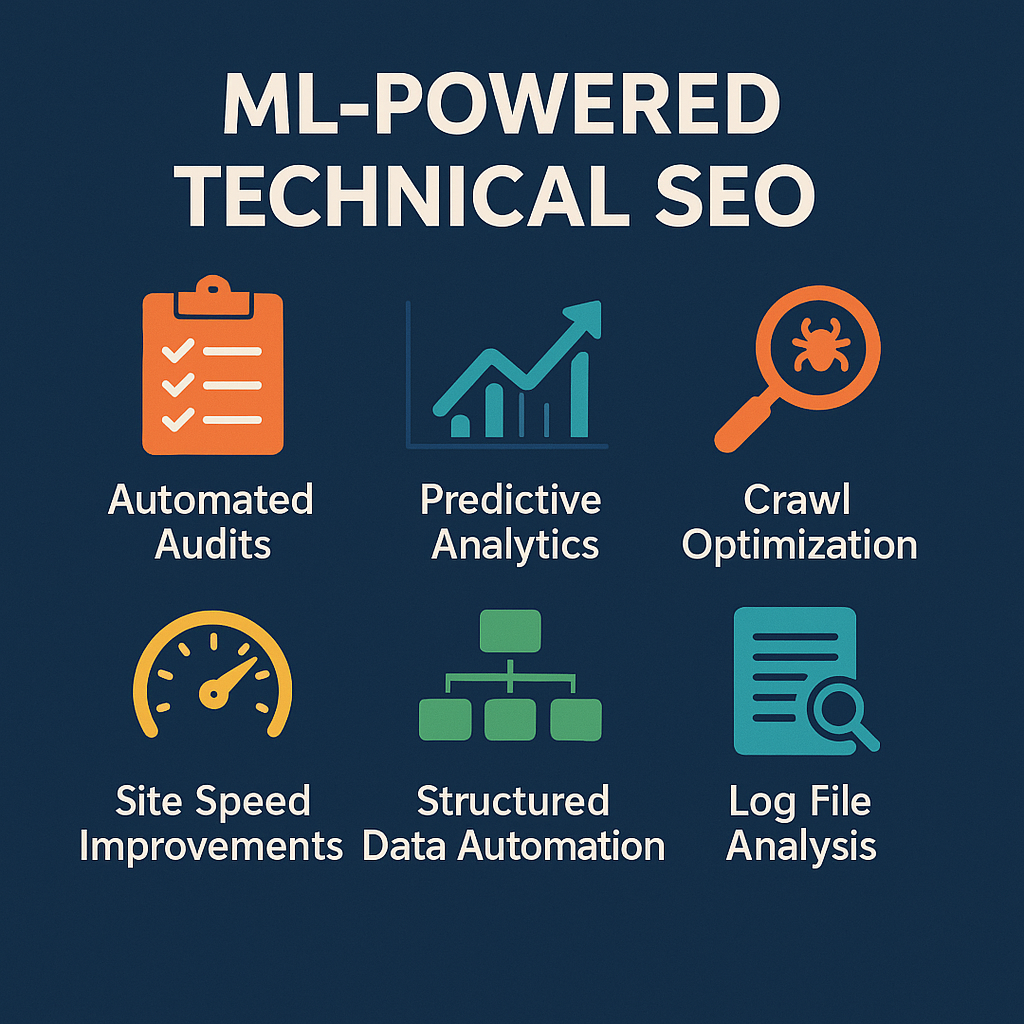
| ML Application | Technical SEO Benefit |
| Automated audits | Rapid, prioritized identification of crawl and index issues |
| Predictive analytics | Proactive response to algorithm updates and trend shifts |
| Crawl optimization | Efficient use of crawl budget via dynamic bot directives |
| Site speed improvements | Faster load times through data-driven resource optimization |
| Structured data automation | Consistent rich results via valid schema markup |
| Log file analysis | Deep insights into bot behavior and server performance |
In Closing
With the progress of the search engines in gaining complexity, the role of machine learning in data-driven SEO for IT firms will be the leading one. As a result of their automated audits, predictions of algorithm changes, crawl behavior optimizations, and the acceleration of site speed improvements, ML enables teams to spend time on strategic innovation instead of tactical firefighting. The addition of these solutions to your technical SEO belt will also ensure that your site architecture and performance always stay in line with the changing priorities of search engines. To turn technical SEO from a compliance exercise into a competitive advantage, start learning and using machine learning today. Consequently, your firm will be guaranteed visibility, relevance, and growth in the digital epoch because you have adopted technologies smarter than your competitors.
Video Description
How to incorporate machine learning into your SEO day-to-day – Lazarina Stoy
In this video, Lazarina Stoy from Tech SEO Connect demonstrates how to seamlessly integrate machine learning into your everyday technical SEO processes. She covers:
- Setting up ML-driven automated audits to spot crawl errors, duplicate content, and misconfigurations at scale.
- Using predictive analytics to forecast Google algorithm updates and proactively adjust site architecture, mobile UX, and content roadmaps.
- Dynamically optimizing crawl budgets with real-time robots.txt rules and XML sitemap updates.
- Leveraging ML tools for site speed improvements through automated image compression, resource prioritization, and adaptive loading.
- Generating and validating structured data via ML-powered entity detection to maintain rich results.
Practical demos of popular SEO platforms illustrate how to interpret ML insights and turn technical SEO into a data-driven competitive advantage.
About the Author